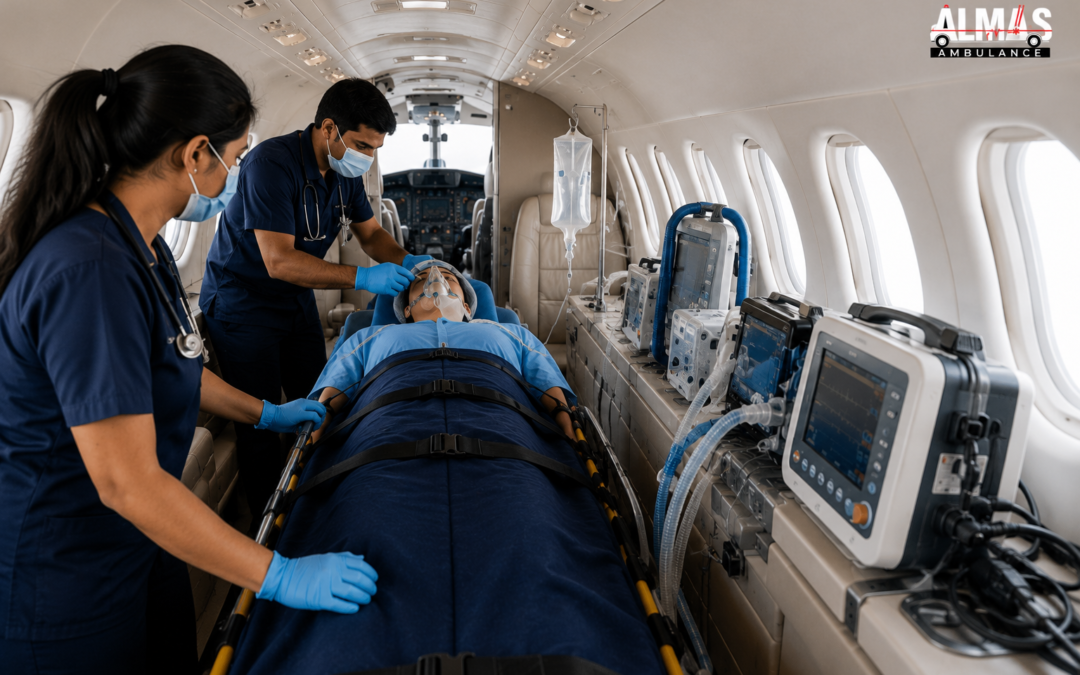
When a patient needs to travel from one country to another for emergency treatment, specialized medical care, or repatriation, arranging a normal flight may not always be possible or medically appropriate. In such situations, Almas provides International Air Ambulance Service a specialized solution for transporting patients safely and efficiently across borders.
Whether a patient is critically ill, recovering after surgery, unable to travel independently, or requires continuous medical supervision, international air ambulance services can coordinate the complete journey—from the patient’s current location to the receiving hospital or final destination.
At Almas Ambulance, we understand that international medical transportation is not simply about booking a flight. It requires careful medical planning, experienced coordination, appropriate equipment, qualified medical professionals, and seamless ground transportation.
This guide explains everything families, hospitals, and medical case managers should know about international air ambulance services.
What Is an International Air Ambulance Service?
An international air ambulance service is a specialized medical transportation solution designed to transfer patients safely between countries using medically equipped aircraft or, when appropriate, commercial flights with professional medical escorts.
Unlike ordinary air travel, an international air ambulance transfer is planned around the patient’s medical condition and transportation requirements.
Depending on the patient’s condition, the transfer may involve:
- Dedicated private air ambulance aircraft
- ICU-equipped medical flights
- Long-distance international medical evacuation
- Medical escort on a commercial flight
- Medical stretcher in commercial flight
- Bed-to-bed patient transportation
- Ground ambulance transfers at both ends
- Coordination with hospitals and medical teams
The primary objective is to ensure that the patient receives the appropriate level of medical support throughout the journey.
Who May Need an International Air Ambulance?
International air ambulance services may be required for patients who cannot safely travel through regular commercial air travel without medical assistance.
Common situations include:
Critically Ill Patients
Patients who require continuous medical monitoring or intensive care may need a dedicated air ambulance equipped with appropriate medical equipment.
This may include patients requiring:
- Ventilator support
- Cardiac monitoring
- Oxygen therapy
- Continuous medical observation
- Intensive care support
Patients Requiring Medical Repatriation
A patient who becomes seriously ill or injured while traveling or living abroad may need to return to their home country for continued treatment or family support.
This is commonly known as international air medical repatriation.
For example, a patient who suffers a serious medical emergency while in the Middle East may require transportation back to India or another home country once medically assessed and cleared for transfer.
Post-Surgery Patients
Some patients may need to return home after undergoing surgery or treatment in another country.
Depending on their medical condition and mobility, they may travel by:
- Dedicated air ambulance
- Commercial stretcher
- Commercial flight with a medical escort
Patients Requiring Specialized Treatment
A patient may need to be transferred internationally because the required treatment or specialist medical facility is not available at their current location.
In such cases, an international medical flight can help connect the patient with an appropriate healthcare facility.
International Air Ambulance vs. Commercial Flight Medical Transfer
One of the most important decisions in international patient transportation is choosing the right mode of travel.
Not every patient requires a private air ambulance.
The appropriate transportation method depends on the patient’s clinical condition, mobility, stability, and level of medical care required.
- Dedicated International Air Ambulance
A dedicated air ambulance is generally considered when a patient requires a higher level of medical supervision or cannot safely travel on a standard commercial flight.
Depending on the patient’s condition, an air ambulance may provide:
- ICU-level medical care
- Ventilator support
- Cardiac monitoring
- Oxygen and other medical equipment
- Qualified medical crew
- Continuous patient monitoring
- Greater flexibility in flight planning
- Direct medical transportation
This option is particularly relevant for critically ill and unstable patients.
- Medical Escort on Commercial Flight
For medically stable patients who can travel in a regular airline seat, a medical escort on a commercial flight may be a suitable and more cost-effective option.
A medical escort can assist with:
- Airport procedures
- Boarding and disembarkation
- Patient mobility
- Medication management
- Basic medical monitoring
- Coordination during the journey
The suitability of commercial air travel must be assessed on an individual basis, and airline medical clearance may be required.
- Medical stretcher in commercial flight
Some patients may be medically stable but unable to remain seated throughout a long international flight.
In such cases, a Medical stretcher in commercial flight arrangement may be considered.
The patient travels on a commercial aircraft with a specially arranged stretcher facility and, when required, medical professionals accompanying the patient.
This can be an alternative to a dedicated private air ambulance for selected patients.
Recent Comments